Pacific Pulse
A 70-year ecosystem early warning system for the California Current — tracking ocean chemistry, biological collapse, and projecting what the ecosystem looks like in 2075.
Project Overview
As the California Current's ocean chemistry shifts, which biological communities collapse first — and what does the ecosystem look like in 2075?
Using 72 years of Scripps/CalCOFI ocean data, Pacific Pulse tracks ecosystem stress across four biological layers and builds an early warning classifier that predicts population collapse from ocean chemistry signals one quarter before it occurs.
Analysis Phases
Analytics
70 years of CalCOFI ocean chemistry and biological response data
Significant Findings
Chlorophyll A is the strongest sardine predictor — higher phytoplankton levels support sardine populations.
Temperature anomaly peaked at +1.75°C in 2015 — the highest value in the 72-year record — coinciding with the lowest sardine larvae counts of the modern era.
Dissolved oxygen is the second strongest sardine predictor. No significant chemistry correlations found for anchovy — El Niño and nutrient signals dominate instead.
Dropped to 21.8 larvae/10m² — the ML model assigned only 0.8% collapse probability, suggesting a non-chemistry driver.
Under linear trend extrapolation, sardine larvae drop to effectively zero in the Southern California Bight by 2050 — a local reproductive collapse under current conditions.
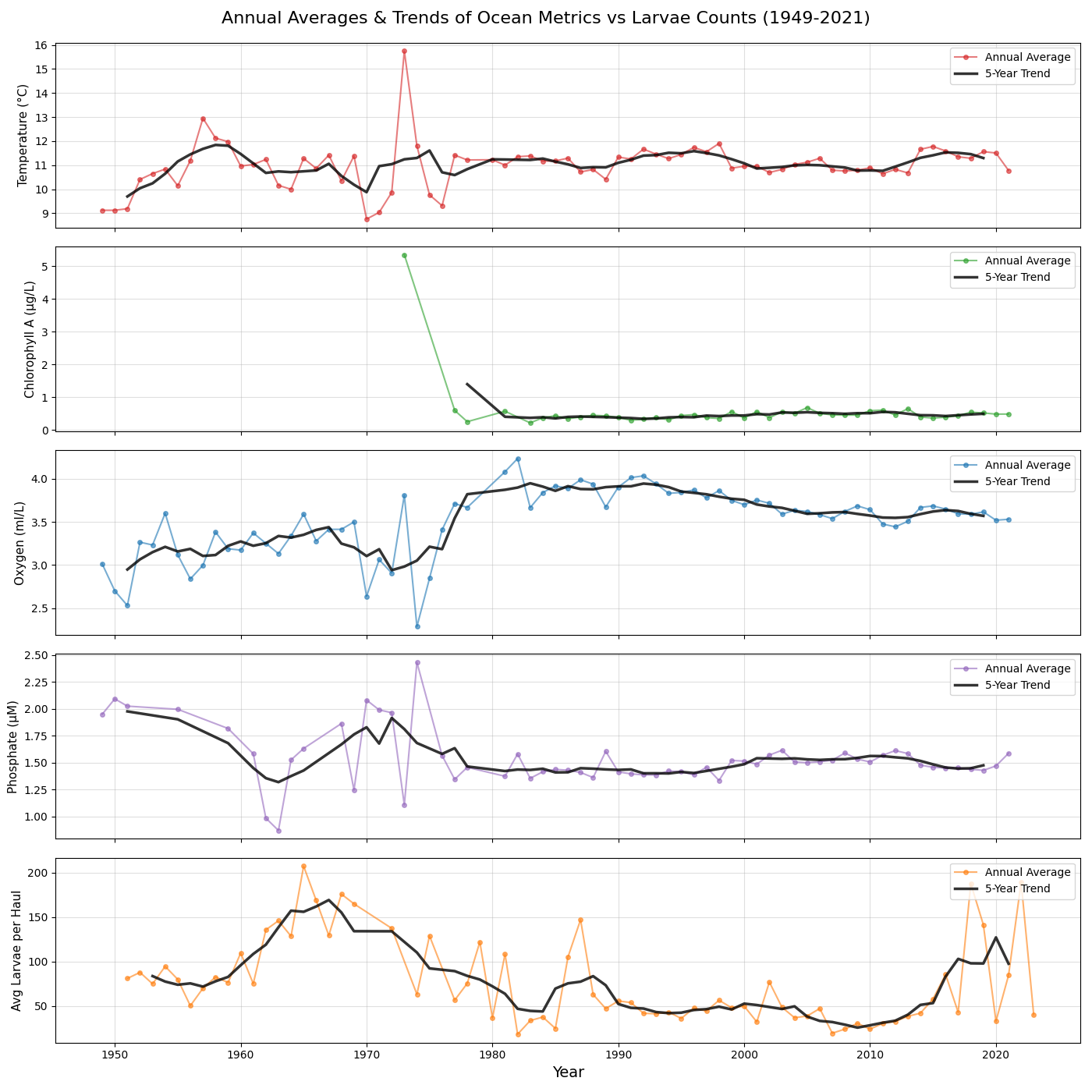
Measuring temperature, oxygen concentration, chlorophyll, phosphate, and larval count along the western coast over the past 70 years. We see a steady decline in oxygen levels over the past 30 years, reflecting findings from research projects like one from Georgia Tech. We see a slow rise in temperature as well. These larger trends seem to explain the overall decline in larvae hauls — with the exception of the anomalies in more recent times — with populations being unable to sustain themselves in worsening conditions.
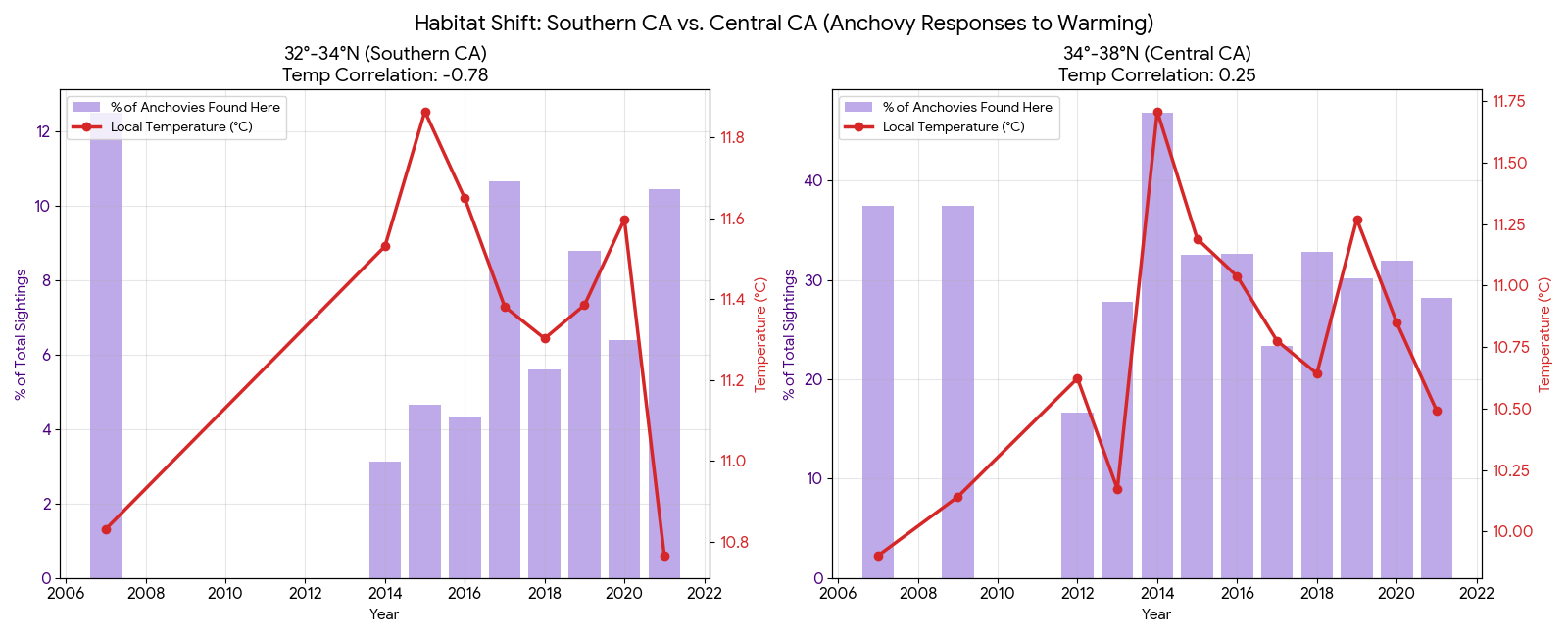
In Southern California, we see a significant negative correlation between temperature and anchovy sightings (measured by number of sightings found in the given area divided by total sightings that year), with a peak in temperature in the mid 2010s correlating with fewer anchovies being seen in Southern California. We see little correlation with a small positive coefficient in the Central California area, which could be explained by warming temperatures reaching more ideal levels for the fish.
ML Model
Gradient boosting early warning classifier for ecosystem collapse
Algorithm: Gradient Boosting Classifier (scikit-learn)
Validation: Temporal split — trained 1990–2010, tested 2011–2021
Collapse definition: Larvae below seasonal 25th percentile
Key Findings
Nitrate accounts for 23.2% of total feature importance in the anchovy classifier — more than any other single variable. Temperature lag and oxygen lag follow at 12.6% and 12.1%.
When the model predicts a collapse quarter it is correct 4 out of 5 times. Recall is lower (40%) — it misses some events, but the false alarm rate is low.
The worst anchovy year on record was not flagged by chemistry or El Niño signals — suggesting a driver outside the current feature set (disease? COVID-19 sampling gaps?).
With only 84 quarterly observations and high natural variability, sardine cannot be classified reliably. This is an honest finding — we report it rather than hiding it.
Adjust nitrate reduction policy and climate scenario to see how clean water probability changes over time. Based on a Random Forest classifier trained on CalCOFI oxygen and nitrate data. Clean water = above-median oxygen AND below-median nitrate.
About
Pacific Pulse — DataHacks 2026
Pacific Pulse was built for DataHacks 2026 using openly available data from the Scripps Institution of Oceanography, NOAA, and OBIS SEAMAP. The project combines 72 years of CalCOFI ocean chemistry measurements with biological response data across multiple trophic levels to build an ecosystem early warning system for the California Current.
Data SourcesUses CalCOFI dataset from Scripps Institution of Oceanography — eligible for the $1,500 Scripps Challenge.